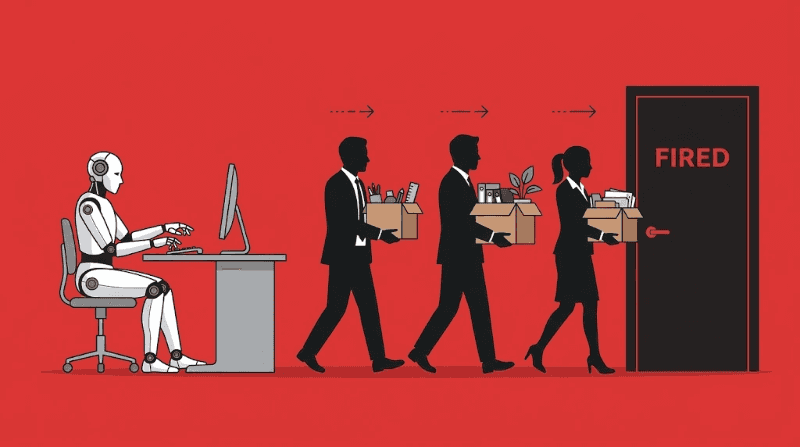
For much of 2026, the message from corporate executives seemed straightforward: artificial intelligence would make businesses more efficient, and fewer employees would be needed to get the work done.
Companies invested in AI tools, reorganized teams, and announced layoffs. Some presented those cuts as an inevitable consequence of automation.
Now, a different story is emerging.
Businesses that reduced their workforce in anticipation of AI-driven productivity gains are discovering that replacing employees is considerably harder than automating individual tasks. In some cases, they’re asking former workers to come back.
Researchers have started calling this phenomenon AI rebounding.
And recent findings suggest it isn’t limited to a handful of companies making headlines.
Nearly One in Five US Workers Report Being Asked Back
A recent CNBC report highlights research from SHL, a talent acquisition and workforce management company.
The study, conducted by Propeller Insights in June and July 2026, surveyed more than 1,000 workers in the United States and more than 1,000 in the United Kingdom.
Nearly one in five US respondents said they had been laid off or replaced because of AI and subsequently invited to return to their former employer.
That’s a striking finding, particularly after months of headlines suggesting that AI-driven job losses would be permanent.
However, there’s an important distinction. The SHL results reflect workers’ self-reported experiences. They don’t establish how many people across the entire economy were replaced by AI, and being invited back doesn’t necessarily mean someone accepted the offer.
Still, the findings suggest that some employers are reconsidering decisions they made only months earlier.
A separate March 2026 study from Orgvue reported that 32% of organizations that had made AI-related workforce reductions subsequently rehired employees.
These two studies measure different things. SHL surveyed workers about their personal experiences, while Orgvue examined organizations and their workforce decisions. The percentages shouldn’t be compared directly.
What they share is a broader message: some companies are discovering that the benefits of automation aren’t as straightforward as they initially expected.
Why AI-Driven Layoffs Aren’t Delivering the Expected Results
The argument for reducing headcount sounds reasonable at first.
If AI can generate reports, write code, answer customer questions, analyze documents, and automate administrative work, companies should theoretically need fewer people.
But that reasoning overlooks a crucial distinction.
Automating tasks is not the same as replacing an employee.
A software developer doesn’t spend an entire working day typing code. The job also involves understanding requirements, investigating production failures, discussing trade-offs, reviewing changes, and deciding which problems are worth solving.
The same applies to customer support, operations, marketing, finance, and countless other professions.
AI can accelerate parts of those jobs without taking responsibility for the complete workflow.
Joseph Fuller, a professor at Harvard Business School, argues that companies make a mistake when they approach AI adoption like a conventional software rollout.
Historically, businesses have often justified technology investments by reducing labor costs. AI, however, creates more complicated organizational challenges.
Its usefulness depends heavily on the knowledge of the people using it.
An experienced employee knows why a particular process exists, which exceptions matter, and what might go wrong when something changes.
That context rarely lives in a single document or database.
Lucy Beaumont, SHL’s global senior vice president of product and design, makes a similar argument. Businesses are recognizing the importance of employees who understand customers, exercise judgment, and maintain human relationships.
AI can process information. That doesn’t automatically mean it understands the consequences of a decision.
The Hidden Costs of Replacing People Too Quickly
The financial case for automation can become less convincing once companies account for the work required to make AI systems reliable.
Deploying an AI tool is only the beginning.
Organizations still need people to validate its output, handle exceptions, investigate failures, maintain integrations, and ensure that automated decisions align with business requirements.
In software development, this becomes particularly visible when AI-generated code moves beyond a local prototype.
Someone still has to understand the architecture, evaluate security implications, maintain the system, and respond when production breaks.
And when experienced employees leave, their knowledge often leaves with them.
The loss may not become obvious immediately. It can take months for an organization to discover that an undocumented workflow, a difficult customer relationship, or a critical technical decision depended on someone who is no longer there.
Research from Orgvue suggests that organizations are still struggling with the complexity of AI adoption.
In another 2026 report, the company highlighted substantial differences between executives and senior managers in their expectations about AI.
For example, 74% of executives expected AI to transform their organization within a year, compared with 47% of senior managers.
That disconnect matters.
The people deciding how much money AI should save aren’t always the people who understand how daily work actually gets done.
Workers Are Willing to Return, but Not on the Same Terms
One of the more interesting findings from SHL’s research is that most displaced workers wouldn’t automatically reject an invitation to return.
Only 6.6% of surveyed US workers said they would refuse under any circumstances.
But willingness to return doesn’t mean everything goes back to normal.
Employees who have already lost their jobs because of an AI initiative have good reasons to question whether the same thing could happen again.
And many want concrete changes before accepting an offer.
According to SHL’s US survey:
- Nearly half would require a substantial salary increase.
- 43% wanted written assurances about job security.
- 40% expected greater transparency about how AI would affect their work.
- 30% wanted an apology or acknowledgment from management.
These preferences aren’t mutually exclusive. A respondent could request several conditions before agreeing to return.
The demands also reflect something deeper than compensation.
A layoff changes the relationship between employer and employee.
When a company tells someone that technology has made their role unnecessary, then asks that person to return, the employee may reasonably question the company’s judgment and long-term plans.
Even if the worker accepts, rebuilding trust can take considerably longer than completing the hiring paperwork.
Rehiring Doesn’t Automatically Repair Company Culture
The consequences of an AI-driven layoff extend beyond the employees who lose their jobs.
Remaining team members may begin wondering whether their positions are next.
They may become less willing to share knowledge, invest in long-term projects, or trust leadership’s promises about future technology initiatives.
When former employees return, they bring those concerns back with them.
This is why simply reversing a layoff can be misleading.
A company can restore a position without restoring the working relationship that existed before the cut.
Employees may negotiate higher salaries, look for alternative opportunities, or become more cautious about their employer’s decisions.
Managers also face the difficult task of explaining why a position considered unnecessary a few months earlier has suddenly become essential again.
The damage isn’t necessarily permanent. But it requires more than announcing that the AI strategy has changed.
Companies need to demonstrate that they’ve learned something from the experience.
What AI Rebounding Means for Software Developers
For developers, this trend deserves particular attention.
AI coding assistants have become increasingly capable. They can generate components, explain unfamiliar code, write tests, refactor functions, and help troubleshoot errors.
More advanced coding agents can work across multiple files, execute commands, and complete substantial development tasks with relatively little supervision.
That progress is real.
But it doesn’t follow that every organization can replace experienced engineers with a collection of AI subscriptions.
Software development involves more than producing source code.
A generated implementation still needs to satisfy business requirements, integrate with existing systems, meet security expectations, and remain maintainable over time.
Consider a developer working on a payment platform.
An AI agent might produce a functional checkout component in minutes. But deciding how that component handles failures, retries, idempotency, fraud detection, and regulatory requirements demands a much broader understanding of the system.
The same applies to database migrations, authentication, distributed systems, and production infrastructure.
AI can reduce the time spent on implementation. It doesn’t automatically eliminate the need for engineering judgment.
The Skills That Become More Valuable
For developers, the practical response isn’t to ignore AI or compete with it at writing boilerplate.
It’s to become better at the parts of engineering that require context, judgment, and accountability.
That includes:
- Understanding system architecture and technical trade-offs.
- Debugging complex behavior across multiple services.
- Reviewing and validating AI-generated changes.
- Identifying security, performance, and maintainability problems.
- Communicating with stakeholders and understanding business requirements.
- Making technical decisions when the available information is incomplete.
Learning to use AI effectively matters too.
A developer who can delegate routine work to an AI agent while recognizing its limitations may become more productive than someone who either refuses to use the technology or trusts every generated result.
The important distinction is between using AI to accelerate engineering and assuming that AI can independently own the entire engineering process.
Employees Are Already Adapting
SHL’s survey also examined how workers are preparing for an AI-driven labor market.
The findings suggest that employees aren’t simply waiting to see whether automation will affect their jobs.
They’re actively developing new capabilities.
Among US respondents:
- 44% were independently learning AI tools.
- 42.6% were developing industry-specific expertise that would be difficult to reproduce through AI.
- 40% were improving communication and leadership skills.
- 38% were focusing on creative and strategic thinking.
These results suggest that workers increasingly recognize the value of combining technical proficiency with human expertise.
Knowing how to use AI is useful. Knowing when its output is wrong, incomplete, or inappropriate may be just as important.
For software developers, that means becoming comfortable with AI-assisted workflows without losing the ability to reason independently about the code they ship.
It also means continuing to learn the fundamentals.
An AI assistant can suggest a database query, but understanding indexes and query execution plans still matters.
It can generate React components, but knowing how rendering, state, and effects work remains essential.
And it can propose a system architecture, but someone needs to evaluate whether that architecture makes sense for the actual product.
The more capable AI tools become, the more valuable it is to understand what they’re doing.
Companies Need a Better AI Strategy Than Cutting Headcount
The emerging pattern doesn’t mean AI has failed.
It means some organizations may have underestimated the complexity of using it effectively.
There’s a significant difference between identifying a process that AI can improve and assuming that everyone involved in that process is now unnecessary.
Before eliminating roles, businesses need to understand what employees actually do, including responsibilities that aren’t reflected in formal job descriptions.
They also need to measure real outcomes rather than relying on optimistic productivity projections.
A team that generates twice as much code isn’t necessarily delivering twice as much value.
A customer service chatbot that resolves more tickets isn’t necessarily improving customer satisfaction.
And an automated workflow that saves several hours each week may still require experienced employees to handle its most important decisions.
The better approach is to redesign work around the strengths and limitations of both people and AI.
That may mean retraining employees, changing responsibilities, introducing new roles, or using automation to free up time for higher-value work.
In some cases, it will still mean fewer positions. In others, it may create demand for skills the organization didn’t previously need.
The point is to make those decisions based on evidence rather than assumptions.
Questions Employers Should Ask Before Replacing Roles
Before making AI-related workforce reductions, organizations should be able to answer several practical questions.
Which tasks can AI reliably complete without human supervision?
Which responsibilities require business context, judgment, or accountability?
How will the company measure productivity improvements beyond the number of automated tasks?
Who will maintain and monitor the AI systems after deployment?
What happens when those systems produce incorrect results or fail?
And perhaps most importantly, can existing employees be retrained to perform higher-value work instead of being replaced?
These questions are less exciting than announcing a major AI transformation.
They’re also much more likely to lead to sustainable improvements.
The Future of Work May Be Less Predictable Than Expected
It’s tempting to interpret AI rebounding as proof that companies overestimated artificial intelligence.
Some probably did.
But the broader picture is more complicated.
AI capabilities continue to improve, and organizations are still learning how to integrate them into existing workflows.
A task that requires extensive human supervision today may become easier to automate tomorrow. At the same time, new tools can create additional work involving integration, quality control, security, and oversight.
That makes long-term workforce planning unusually difficult.
Joseph Fuller argues that adaptability will become increasingly important as organizations repeatedly adjust their processes and staffing needs.
For employees, that means developing the ability to learn new tools, work across changing responsibilities, and apply existing expertise in unfamiliar situations.
For employers, it means treating workforce development as part of AI adoption rather than an expense to eliminate before the technology has proved itself.
Final Thoughts
The AI rebound reveals an uncomfortable truth about automation: it’s often easier to demonstrate what a technology can do than to understand everything a person contributes.
Companies can measure the time saved by an AI-generated report or a completed coding task. Measuring judgment, institutional knowledge, trust, and the ability to handle unexpected problems is much harder.
That doesn’t make those contributions less valuable.
The lesson isn’t that AI won’t replace jobs. Some roles will change dramatically, and others may disappear.
It’s that replacing individual tasks with AI doesn’t automatically mean a business can function without the people who used to perform them.
For software developers and other technology professionals, the best long-term strategy is to learn how to work effectively with AI while strengthening the expertise that makes its output useful.
And for companies, the message is equally important: before deciding which employees AI can replace, make sure you understand what those employees actually do.
Rehiring them later may be possible.
Rebuilding their trust is another matter.
Sources and Further Reading
-
CNBC — AI Rebounding Employees. October 30, 2026. Reporting on SHL’s survey and expert commentary.
-
Orgvue — New Research Exposes the Complexity of Deploying AI Systems in the Workforce. March 2026. Research on AI-related workforce reductions and subsequent rehiring.
-
Orgvue — Unintentional Decision-Making Sets Up AI Deployments to Fail. March 2026. Research into organizational expectations and AI workforce planning.
-
Associated Press — What to Consider if a Company That Made AI-Related Job Cuts Wants You Back. Additional context on rehiring, employee expectations, and negotiating a return.