JavaScript moves fast — and staying up to date can feel overwhelming. Each week we curate the most relevant updates, new libraries, and ecosystem changes so you don’t have to dig through 50 tabs and timelines. From framework releases to niche tooling improvements, this collection is designed to give developers a quick pulse check on what matters right now.
Welcome to edition #33 of Friday Links — your weekly window into the ever-evolving JavaScript ecosystem.

OpenAI Launches ChatGPT Health
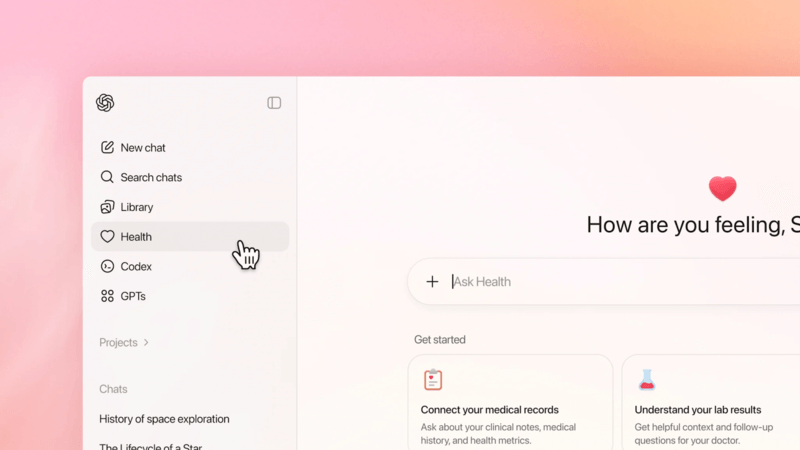
OpenAI has introduced ChatGPT Health, a dedicated section inside ChatGPT focused entirely on personal health. It’s more than a themed chat — users can discuss symptoms, interpret lab results, track metrics over time, and get clear explanations of medical terms.
A key feature is integration with health and fitness services. Users can connect Apple Health, MyFitnessPal, and similar apps so the AI can analyze sleep, activity, nutrition, and wellness trends. In the U.S., it can also sync with electronic health records for reviewing test results and medical history.
Privacy is a major emphasis: ChatGPT Health uses separate infrastructure with layered encryption, and its data is not used to train base models or mixed with regular chats by default.
📜 Articles & Tutorials
Mathematics for Computer Science
React2Shell exploit: What happened and lessons learned
Azure Boards integration with GitHub Copilot
Automatically load .env files in Node.js scripts
Streaming JSON in just 200 lines of JavaScript
Introducing WebF Beta: Bring JavaScript and the Web dev to Flutter
Ink 6.6 — a library for building CLI apps with React, used by Claude Code, Gemini CLI, and others.
Olmo 3: Fully Open-Source LLM from AI2 (Models, Data, & Code)
Use native dialog with Turbo (and no extra JavaScript)
How microservice architectures have shaped the usage of database technologies
TypeScript Types as a Programming Language
⚒️ Tools
A new free open-source service called Maltrail has been released for analyzing inbound and outbound network traffic and detecting malware. The project can:
- detect malicious domains, URLs, and IP addresses
- identify harmful HTTP User-Agent strings
- spot modern attack tools on workstations
- provide strong network security without complex setup — installable in one click
- help reveal viruses, miners, and other unwanted network-active software
npmgraph is a web-based tool that visualizes npm package dependencies. You can enter one or more package names (or upload a package.json) to see how their dependency graphs intersect. It also supports coloring packages by different metrics (like number of maintainers) and exporting the result as an SVG.
Bruno - Bruno is a fully local and Git-native solution to accelerate and secure API work and collaboration
Free Certifications - A curated list of free courses with certifications.
worktrunk - A CLI tool to manage multiple worktrees in Git repositories.
The Concise TypeScript Book - A concise and practical guide to TypeScript, covering essential concepts and features.
Vibium - Browser automation for AI agents and humans.
📚 Libs
ConvertX - Self-hosted online file converter. Supports 1000+ formats.
Fabric.js 7 - is a JavaScript library for working with the HTML5 canvas. It runs in both browsers and Node (via node-canvas) and provides an object model for canvas elements along with SVG-to-canvas and canvas-to-SVG conversion. The project also offers many demos with full source code.
jsPDF - Client-side JavaScript PDF generation for everyone.
JoltPhysics.js - A JavaScript/WebAssembly port of the Jolt Physics engine for real-time physics simulation in web applications.
ChordSheetJS - A JavaScript library for parsing and formatting chords and chord sheets
PlayCanvas Model Viewer - A JavaScript library for displaying 3D models in the browser using WebGL and WebXR.
recharts - A composable charting library built on React components and D3.js.
nats.js - JavaScript client for Node.js, Bun, Deno and browser for NATS, the cloud native messaging system
bundlemon - A tool to monitor and enforce bundle size budgets for JavaScript projects.
tinypdf - A lightweight PDF manipulation library for Node.js and the browser.
Markdown UI - An open standard for rendering interactive widgets in plain Markdown.
⌚ Releases
file-type 21.2 - Detect the file type of a file, stream, or data
Fast HTML Parser 7.0.2 Released
Middy 7.0 brings middleware to AWS Lambda for Node.js, now with Durable Functions support.
Node File Trace 1.2 - determines the minimal set of files required for an app to execute.
Orange ORM 4.8 — an Object-Relational Mapper for Node, Bun, and Deno.
Repomix 1.11 — package an entire repository into a single, LLM-friendly file.
hot-shots 12.0 / 12.1 — a Node.js client for statsd, DogStatsD, and Telegraf.
Color.js v0.6 — a standards-compliant color conversion and manipulation library — moves closer to its 1.0 release.
Nitrux 5.1.0 Released — a Linux distribution based on Debian, featuring the KDE Plasma desktop environment.
📺 Videos
I Reviewed 3 REAL React Native Apps (Here’s what I thought)
2026 UI/UX Design Trends - 2 of the Biggest Trends
An Open-Source Alternative to ElevenLabs
PERN Stack Course: Build a Full Stack Product Store with React and Postgres
Build and Deploy a Real Time Crypto Screener & Dashboard App | WebSocket API with Next.js
3 React Experts vs 1 React Interview Challenge | Kent C. Dodds, Jack Herrington & Roadside Coder
Figma MCP vs Claude: UI Building Battle!
The Best React Native Tech Stack for 2026
How To Become Elite at Programming
99% of Developers Don’t Get gRPC
🎤 Talks & Podcasts
No content this week 😢
🗞️ News & Updates
Google AI and Vercel Sponsor Tailwind After 80% Revenue Drop Caused by AI

Logan Kilpatrick, Head of Product at Google AI Studio, posted on X that the Google AI team is now a Tailwind sponsor and added:
“I’d love to discuss how we can do more together.”
Guillermo Rauch, CEO of Vercel, also confirmed sponsorship.
Why It Happened
According to Wathan, the crisis was caused by a broken sales funnel. Previously:
- developers googled CSS questions,
- landed on Tailwind’s documentation,
- discovered paid products like component kits and templates.
With modern LLMs such as Claude, ChatGPT, and Cursor, developers now generate code directly. Since LLMs were trained on Tailwind documentation, they produce accurate solutions without the developer visiting the site.
The result:
- documentation traffic dropped 40% since early 2023
- Tailwind reached 75 million downloads/month, making it more popular than ever
- revenue collapsed despite adoption increasing
How Much Sponsorship Was Provided?
Google and Vercel did not disclose amounts. Tailwind’s public sponsorship tiers start at:
- $6,000/year (base tier)
- $60,000/year (top partner tier)
Before today, Tailwind already received ≈$1.1M/year from 29 corporate sponsors, including Cursor. Despite that, layoffs were unavoidable — only one engineer remains from the original four.
Why This Matters
This situation raises a deeper question about the relationship between AI companies and open-source projects:
- LLMs generate Tailwind code constantly,
- If Tailwind stalls, LLMs will output outdated patterns,
- Open-source maintainers currently absorb the costs without AI companies contributing back.
For now, three engineers have already lost their jobs, new sponsorship sums remain undisclosed, and only time will tell whether this was a one-time PR move or the start of systemic open-source funding from AI companies.
OpenAI, Anthropic, and Google Share the Top Spot in Intelligence Index 4.0
The platform Artificial Analysis has published the fourth edition of its Intelligence Index, one of the strictest rankings of modern AI models. In this update, the report recorded an effective three-way tie between the largest players. Formally, GPT-5.2 (X-High) takes first place, but Claude Opus 4.5 from Anthropic and Gemini 3 Pro from Google trail by only a statistically insignificant margin.
The key change in version 4.0 is methodology. The authors deliberately toughened evaluation criteria and abandoned the familiar benchmarks that models have become highly optimized for in recent years. As a result, absolute scores dropped: where leaders previously scored above 70, the new ceiling is closer to 50. This isn’t model degradation — it’s an attempt to restore genuine difficulty to the measurements.
New year, new Artificial Analysis Intelligence Index! Announcing Intelligence Index v4.0: incorporating 3 new evaluations, further aligning to real-word use and reducing saturation
— Artificial Analysis (@ArtificialAnlys) January 6, 2026
The Artificial Analysis Intelligence Index is our synthesis metric for assessing generalist model… pic.twitter.com/HuUZ0XoFlO
Micro QuickJS: a JavaScript Engine for Embedded Devices Using Only 10 KB of RAM
Fabrice Bellard — creator of QEMU, FFmpeg, QuickJS, TinyGL, and TinyCC — has introduced Micro QuickJS, an open-source JavaScript engine designed for embedded systems. It can compile and execute JavaScript programs with as little as 10 KB of RAM. The codebase is written in C and published on GitHub under the MIT license.
With its bundled C library, Micro QuickJS occupies roughly 100 KB of flash memory. The engine supports both JS → bytecode compilation and direct bytecode execution.
- tracing garbage collector (QuickJS uses ref-counting)
- custom memory allocator (no
malloc()) - stackless virtual machine with different object layout
- UTF-8 string storage
- standard library generated at compile-time and stored in flash
- single-pass bytecode generation + optimization (QuickJS uses multiple passes)
In short, Micro QuickJS brings a modern JavaScript runtime to microcontrollers and constrained hardware, where memory budgets are measured in kilobytes rather than megabytes.
The results of the State of HTML 2025 survey are now available.
That wraps up this week’s picks. If you found something useful, feel free to share the thread with other developers or drop a link you think should appear in the next edition. The JavaScript ecosystem grows through shared exploration — see you next Friday with more trends, tools, and news.