If you’ve been building frontend applications for a while, you’ve probably encountered both the Observer pattern and the Publish-Subscribe (Pub/Sub) pattern.
They often look almost identical. Both involve listeners, callbacks, and notifications. Both allow multiple parts of an application to react when something changes.
Because of these similarities, developers frequently use the names interchangeably. In reality, they solve different problems and lead to different application architectures.
Understanding where they differ helps you design applications that are easier to scale, test, and maintain.
Let’s compare both patterns using the same real-world example.
A Common Frontend Scenario
Imagine you’re building a real-time stock dashboard.
A WebSocket connection continuously receives market updates.
Several independent parts of the application need those updates:
- a price chart
- a watchlist
- a notification panel
- an activity log
The WebSocket should not care who consumes the data. It simply receives new market information.
There are two common ways to distribute those updates.
Option 1: The Observer Pattern
With the Observer pattern, the subject directly keeps track of every observer.
Whenever new data arrives, it loops through every registered observer and calls them one by one.
class Subject {
  #observers = new Set();

  subscribe(observer) {
    this.#observers.add(observer);
    return () => this.#observers.delete(observer);
  }

  notify(payload) {
    this.#observers.forEach(observer => observer(payload));
  }
}
Usage is straightforward.
const ticker = new Subject();

const drawChart = (tick) => {};
const flashRow = (tick) => {};
const logTick = (tick) => {};

ticker.subscribe(drawChart);
ticker.subscribe(flashRow);
ticker.subscribe(logTick);

socket.addEventListener("message", event => {
  ticker.notify(JSON.parse(event.data));
});
Here, the ticker object knows every consumer.
Whenever new market data arrives, it actively notifies each observer.
Characteristics
- The subject owns the list of observers.
- Every observer receives every update.
- Consumers are directly connected to the data source.
- Adding a new observer only requires calling
subscribe().
This creates a clear one-to-many relationship between a single source of truth and its consumers.
Option 2: Publish-Subscribe
The Publish-Subscribe pattern introduces an intermediary.
Instead of sending updates directly to consumers, publishers emit events into an event bus.
Subscribers simply listen for the events they care about.
class EventBus {
  #events = {};

  on(event, callback) {
    (this.#events[event] ||= []).push(callback);
    return () => this.off(event, callback);
  }

  off(event, callback) {
    this.#events[event] =
      this.#events[event]?.filter(cb => cb !== callback);
  }

  emit(event, ...args) {
    this.#events[event]?.forEach(cb => cb(...args));
  }
}
Using the event bus looks very similar.
const bus = new EventBus();

bus.on("tick", drawChart);
bus.on("tick", flashRow);
bus.on("tick", logTick);

socket.addEventListener("message", event => {
  bus.emit("tick", JSON.parse(event.data));
});
The important difference is that the WebSocket never communicates with the consumers directly.
It only emits an event.
The event bus decides who receives it.
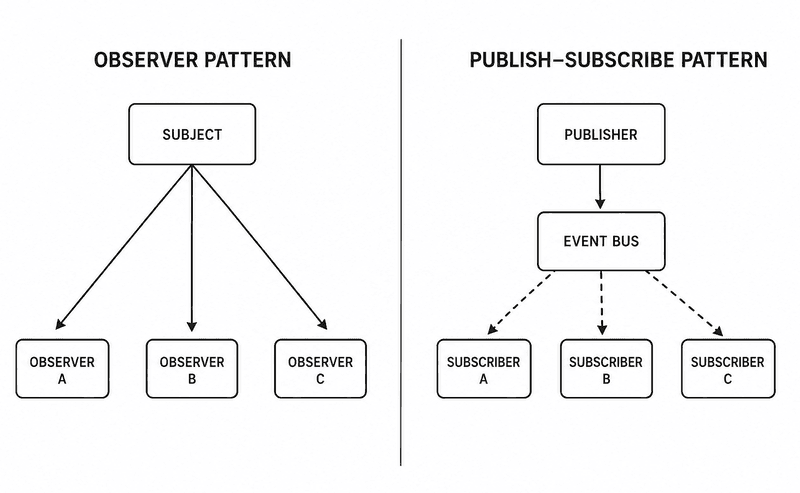
The Key Difference
At first glance, both implementations produce the same result.
The architecture, however, is completely different.
Observer
WebSocket
      │
      ▼
   Subject
      │
 ┌────┼────┐
 ▼    ▼    ▼
Chart List Logger
The subject knows every observer.
Communication is direct.
Publish-Subscribe
WebSocket
      │
      ▼
  Event Bus
      │
 ┌────┼────┐
 ▼    ▼    ▼
Chart List Logger
Neither the publisher nor the subscribers know about each other.
The event bus sits between them.
This extra layer creates much looser coupling.
Where You’ll Find the Observer Pattern
Many frontend APIs are built around Observer semantics.
React State Subscriptions
React doesn’t implement the classic Observer pattern internally in the same way as Vue, but the pattern appears throughout the React ecosystem.
When a component subscribes to an external store, it automatically re-renders whenever the relevant state changes. Libraries like Redux, Zustand, MobX, Jotai, and React’s own useSyncExternalStore API all rely on this idea.
Each store maintains a list of subscribers. When the state changes, it notifies those subscribers, allowing React to update only the components that depend on the changed data.
The relationship is still the same: a single source of state owns its subscribers and informs them whenever its data changes.
Browser Observer APIs
Modern browsers also provide several observer-based APIs.
Examples include:
IntersectionObserverMutationObserverResizeObserver
Each watches a specific target and triggers callbacks whenever that target changes.
Again, the observed object directly manages its observers.
State Management Libraries
Several state management solutions also follow Observer principles.
Examples include:
- MobX
- Signals
- SolidJS reactivity
- Angular Signals
All of them maintain explicit relationships between observable state and dependent computations.
Where Publish-Subscribe Shines
Pub/Sub becomes much more useful when modules should remain independent.
A publisher shouldn’t know who is listening.
A subscriber shouldn’t know who produced the event.
Cross-Component Communication
Lightweight event buses are common in both React and Vue applications.
One popular choice is mitt.
import mitt from "mitt";

type Events = {
  "user-login": {
    userId: string;
    name: string;
  };
};

export const eventBus = mitt<Events>();
Publishing an event:
eventBus.emit("user-login", {
  userId: user.id,
  name: user.name,
});
Listening for it:
useEffect(() => {
  const handler = data => setUser(data);

  eventBus.on("user-login", handler);

  return () => {
    eventBus.off("user-login", handler);
  };
}, []);
The login component doesn’t know who reacts to the event.
The navigation bar doesn’t know where the event originated.
Both only communicate through the event bus.
Micro-Frontends
Micro-frontend architectures frequently use Pub/Sub.
Independent applications often communicate through shared event buses rather than importing each other’s code directly.
This keeps teams independent while allowing applications to exchange information.
Custom Events
The browser’s own CustomEvent system is another example of Publish-Subscribe.
Components dispatch events.
Other components listen for them.
Neither side depends on the other.
A Common Mistake: Forgetting to Unsubscribe
Both patterns rely on callbacks.
That means both can create memory leaks.
If callbacks remain registered after a component has been destroyed, the JavaScript garbage collector cannot release the associated memory.
In React, always clean up subscriptions inside useEffect.
useEffect(() => {
  eventBus.on("update", handler);

  return () => {
    eventBus.off("update", handler);
  };
}, []);
In Vue, remove subscriptions inside onUnmounted().
Ignoring cleanup may not cause immediate problems, but over time it can lead to unnecessary memory usage and unexpected behavior.
Choosing the Right Pattern
| Scenario | Best Choice |
|---|---|
| Reactive state updates | Observer |
| Vue reactivity | Observer |
| Browser observer APIs | Observer |
| Cross-component events | Publish-Subscribe |
| Global notifications | Publish-Subscribe |
| Micro-frontends | Publish-Subscribe |
| Topic-based messaging | Publish-Subscribe |
A simple rule of thumb works well:
Choose Observer when there is a clear ownership relationship between data and its consumers.
Choose Publish-Subscribe when independent modules simply happen to be interested in the same events.
Performance Considerations
Performance differences are usually small, but the architecture matters.
Observer implementations often have slightly lower overhead because notifications are sent directly to observers.
Publish-Subscribe systems add an extra routing layer, but they provide much greater flexibility.
In large applications, maintainability is usually more valuable than the tiny runtime cost of an event bus.
The better choice depends more on system design than on raw performance.
Final Thoughts
Observer and Publish-Subscribe are closely related, but they solve different architectural problems.
The Observer pattern creates direct dependencies between a data source and its consumers. This makes it ideal for reactive systems, state management, and browser observers.
Publish-Subscribe introduces an event broker between producers and consumers. That additional layer removes direct dependencies and makes independent modules much easier to connect.
The easiest way to remember the distinction is this:
- Observer connects objects directly.
- Publish-Subscribe connects objects through an event bus.
Once you recognize that difference, choosing the right pattern becomes much more straightforward, and your frontend architecture becomes easier to extend as your application grows.